All seasons
Episodes
Seven seasons and counting. Cases from across the world — dissected, debated and brought to life by two former detectives who've seen it all.
306 episodes
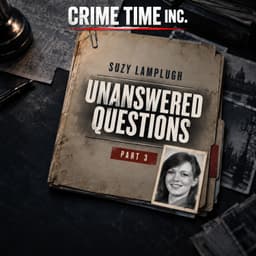
Suzy Lamplugh — Part 3: John Cannan, Steve Wright and the Unanswered Questions
In the concluding episode of Crime Time Inc’s three-part examination of the disappearance of Suzy Lamplugh, former Metropolitan Police detective Mike Barley reflects on an investigation that has remained with him for forty years. Mike considers why the appointment with “Mr Kipper” was different from every other entry in Suzy’s diary, the limitations facing detectives before modern computer and forensic systems, and the emotional burden of living with an unresolved case. He also answers one of the most difficult questions an investigator can face: knowing what he knows now, what does he believe the police got right—and what would he have done differently? The discussion examines several potentially important decisions. Should witnesses have been asked to produce a description of the woman seen with the unidentified man? Did the photograph originally released accurately reflect Suzy’s appearance when she disappeared? Should John Cannan have been interviewed again? And was an opportunity lost when a proposed search of Norton Barracks was refused? Mike explains how John Cannan’s death in prison affected him and why it finally persuaded him to record the investigation from the inside in a book written with Russell Barnes: Suzy Lamplugh: The Inside Story of Britain’s Most Notorious Missing Person Investigation. After Mike’s interview, Tom Wood and Simon McLean review all three episodes. They consider how a major investigation changes when the initial activity subsides, the danger of becoming fixed upon one suspect and the importance of separating evidence from theory. Simon also raises convicted serial murderer Steve Wright, sometimes called the Suffolk Strangler. Wright and Suzy had both worked aboard the QE2, and Wright’s former wife reportedly claimed she had seen them speaking. Tom tests that suggested connection against the available timeline, victimology and known patterns of offending—and explains why an intriguing possibility is not the same as evidence. The episode concludes with a wider reflection on the responsibilities detectives carry towards victims and their families, and why the success of an investigation cannot always be measured solely by whether somebody is convicted. No person has ever been convicted in connection with Suzy Lamplugh’s disappearance. Opinions expressed about possible suspects are identified as investigative assessments or theories, not established findings of fact. Listen now to the final part of Crime Time Inc’s conversation with Mike Barley. Real cases. Real detectives. Real talk. 00:00 — Cold open: John Cannan’s death 00:55 — Suzy’s false appointment with “Mr Kipper” 02:13 — The houses-for-sale attacks 02:53 — Investigating before HOLMES and modern technology 04:50 — Thirteen years carrying the case 08:02 — The Suzy Lamplugh Trust and Cannan’s final years 09:54 — What did the investigation get right and wrong? 13:41 — Norton Barracks and the search that never happened 15:10 — Did the original photograph accurately depict Suzy? 16:27 — Why Mike Barley finally wrote the book 22:50 — Tom and Simon begin their review 24:12 — How a major investigation becomes a cold case 28:21 — Suspect fixation and investigative objectivity 30:49 — Steve Wright, the QE2 and the suggested connection 35:57 — Testing historical theories against the evidence 37:08 — Offender patterns and body disposal 40:40 — Tom and Simon assess the police investigation 43:43 — Could John Cannan have been interviewed differently? 46:51 — The Lamplugh family and the detectives 48:09 — Justice, compassion and what success really means 52:03 — Closing reflections Mike Barley & Russell Barnes — Suzy Lamplugh: The Inside Story of Britain’s Most Notorious Missing Person Investigation UK: Amazon UK https://www.amazon.co.uk/dp/B0GX81YK1N Outside the UK: Search Amazon in your local country for ASIN B0GX81YK1N About Crime Time Inc. Season 5 of Crime Time Inc. broadens its reach across two sides of the Atlantic. This season features cases from Scotland and across the wider UK — rooted in real investigative experience — alongside deep dives into some of the most infamous murder cases in American history. Hosted by former detectives Simon and Tom, with experience in both the UK and the United States, including time working alongside the FBI, the show strips away sensationalism to explain how crime and justice really work. Two crime worlds. One podcast. New episodes released regularly throughout the season. Our Website: https://crimetimeinc.com/ If you like this show please leave a review. It really helps us. Please help us improve our Podcast by completing this survey. http://bit.ly/crimetimeinc-survey Hosted on Acast. See acast.com/privacy for more information.

Suzy Lamplugh Part 2: John Cannan and the One-Word ‘Confession’
In Part 2, Tom Wood continues his conversation with former Metropolitan Police detective Mike Barley about the disappearance of Suzy Lamplugh. Mike explains how the investigation into the abduction and murder of Shirley Banks brought convicted killer John Cannan to the attention of the Lamplugh inquiry. A bungled robbery, a discarded vehicle tax disc and Shirley’s repainted Mini—fitted with a mysterious false registration plate—created a trail investigators could not ignore. Mike also recounts his 1990 prison interview with Cannan. When challenged about his claim that a “Bristol businessman” was responsible for the deaths of Suzy Lamplugh, Shirley Banks and another woman, Cannan gave a one-word answer before immediately retracting it. Mike explains why he regarded that brief exchange as a confession. He then sets out his theory about the “Mr Kipper” appointment in Suzy’s diary, where she may have been abducted and why he wanted the disused Norton Barracks searched. After the interview, former detectives Tom Wood and Simon McLean examine the evidence, Cannan’s patterns of offending and the difficult balance between pursuing an experienced detective’s instincts and maintaining discipline within a major investigation. John Cannan was convicted of murdering Shirley Banks. He was never charged with or convicted of involvement in Suzy Lamplugh’s disappearance. Mike Barley makes clear that his conclusion is his personal investigative belief—not proof established in court. Content warning: This episode contains discussion of abduction, sexual violence and murder. CHAPTERS 00:00 — Cold open: the one-word answer 00:43 — Shirley Banks and the first link to John Cannan 04:13 — A former partner’s account and Norton Barracks 07:22 — Cannan’s conviction and criminal history 10:49 — Testing Cannan’s account of his movements 12:48 — How Shirley Banks was abducted 15:22 — Preparing for the Wakefield Prison interview 19:31 — The SLP number plate and Cannan’s answer 24:26 — Mike’s theory about Suzy’s disappearance 28:15 — The Norton Barracks search that never happened 30:48 — Tom and Simon review the interview 38:39 — Did Mike become too close to the investigation? 40:02 — Leadership, resources and the missed search 43:39 — HOLMES and managing a cold case 44:53 — Hunches, hierarchy and investigative discipline 49:07 — Next time on Crime Time Inc. Crime Time Inc.—Real cases. Real detectives. Real talk. Find more at CrimeTimeInc.com. Mike Barley & Russell Barnes — Suzy Lamplugh: The Inside Story of Britain’s Most Notorious Missing Person Investigation UK: Amazon UK https://www.amazon.co.uk/dp/B0GX81YK1N Outside the UK: Search Amazon in your local country for ASIN B0GX81YK1N About Crime Time Inc. Season 5 of Crime Time Inc. broadens its reach across two sides of the Atlantic. This season features cases from Scotland and across the wider UK — rooted in real investigative experience — alongside deep dives into some of the most infamous murder cases in American history. Hosted by former detectives Simon and Tom, with experience in both the UK and the United States, including time working alongside the FBI, the show strips away sensationalism to explain how crime and justice really work. Two crime worlds. One podcast. New episodes released regularly throughout the season. Our Website: https://crimetimeinc.com/ If you like this show please leave a review. It really helps us. Please help us improve our Podcast by completing this survey. http://bit.ly/crimetimeinc-survey Hosted on Acast. See acast.com/privacy for more information.

Suzy Lamplugh: Inside the Investigation | Mike Barley Part 1
On 28 July 1986, 25-year-old estate agent Suzy Lamplugh left her Fulham office for an appointment with a prospective client recorded in her diary as “Mr Kipper”. She never returned. That evening, Metropolitan Police detective Mike Barley was called at home. The duty detective inspector had heard the circumstances and told him: “I don’t like the sound of it. I think you’d better come in.” In Part 1 of this three-part Crime Time Inc. special, Mike gives Tom Wood a first-hand account of the opening stages of one of Britain’s most enduring missing-person investigations. Mike recalls the discovery of Suzy’s white Ford Fiesta and the details that immediately concerned detectives: the unlocked driver’s door, the handbrake off, the driver’s seat pushed back and the car left awkwardly positioned. He explains the search for witnesses, the artist’s impression and photo-fit, the huge national media response and the flood of information into the incident room. At its height, almost 100 officers were involved. With no modern computerised major-incident system, investigators relied on a manual card index that eventually contained more than 26,000 cards. Mike also describes the painful moment police told Suzy’s parents, Paul and Diana Lamplugh, that they believed their daughter was dead — while still being unable to tell them either “we’ve got him” or “we’ve found her”. As months passed, resources dwindled until only four officers remained on the inquiry. After Mike’s account, Simon McLean and Tom Wood review the investigation from their own policing experience. Tom returns in particular to the condition and position of Suzy’s car, reaching a stark conclusion: “The car was dumped, not parked.” This is Season 7, Episode 10 and Part 1 of a three-part Crime Time Inc. interview with former Metropolitan Police detective Mike Barley. CHAPTERS 00:00 Cold Open: “I Think You’d Better Come In” 00:45 Simon and Tom Introduce the Case 02:52 Mike Barley Joins Crime Time Inc. 05:24 “Mr Kipper” and Suzy’s Final Appointment 09:11 Suzy’s Car Is Found 10:36 Police Treat the Case at Its Most Serious 15:54 Witness Sighting and Artist’s Impression 16:52 The Case Explodes in the National Press 18:23 From Artist’s Impression to Photo-Fit 20:58 Telling Suzy’s Parents Police Believe She Is Dead 22:22 The 26,000-Card Incident Room 25:28 Nearly 100 Officers — Then the Team Shrinks 26:12 The National Missing Person Helpline 28:11 Simon and Tom Review the Investigation 36:07 “The Car Was Dumped, Not Parked” 37:33 Next Time on Crime Time Inc. Mike Barley & Russell Barnes — Suzy Lamplugh: The Inside Story of Britain’s Most Notorious Missing Person Investigation UK: Amazon UK https://www.amazon.co.uk/dp/B0GX81YK1N Outside the UK: Search Amazon in your local country for ASIN B0GX81YK1N About Crime Time Inc. Season 5 of Crime Time Inc. broadens its reach across two sides of the Atlantic. This season features cases from Scotland and across the wider UK — rooted in real investigative experience — alongside deep dives into some of the most infamous murder cases in American history. Hosted by former detectives Simon and Tom, with experience in both the UK and the United States, including time working alongside the FBI, the show strips away sensationalism to explain how crime and justice really work. Two crime worlds. One podcast. New episodes released regularly throughout the season. Our Website: https://crimetimeinc.com/ If you like this show please leave a review. It really helps us. Please help us improve our Podcast by completing this survey. http://bit.ly/crimetimeinc-survey Hosted on Acast. See acast.com/privacy for more information.

The War on Drugs: Has Prohibition Failed?
Nearly twenty years ago, one of Scotland’s most respected legal figures delivered a devastating verdict on the war on drugs: prohibition was not working. In this episode, former detectives Simon McLean and Tom Wood revisit the views of Lord John McCluskey and ask whether decades of criminalisation have reduced drug use — or helped create the hugely profitable black market exploited by organised crime. Simon argues for a radically different approach built around decriminalisation, regulation and rehabilitation. Tom challenges the practicalities: who would supply regulated drugs, could easier access increase consumption, and does Scotland have anything like the treatment infrastructure required? They examine Scotland’s record on drug deaths, the relationship between drugs and organised crime, and lessons from approaches used overseas. Tom also reflects on his own experience working in alcohol and drug strategy and raises a crucial question about drug deaths: rather than looking only at how someone died, should we pay much more attention to how they lived in the years beforehand? The discussion then turns to Scots law and Brennan v HM Advocate, a murder case involving alcohol, LSD and the important legal principle surrounding voluntarily induced intoxication, insanity and diminished responsibility. A frank discussion about drugs, crime, health, law — and whether continuing with the same policies can ever produce a different result. Real cases. Real detectives. Real talk. Chapters 00:00 — Cold Open: The War on Drugs Has Failed 00:53 — Lord McCluskey and Scots Law 03:54 — “It Does Not Work. It Cannot Work.” 05:03 — Tom Remembers John McCluskey 06:48 — Is Prohibition Causing the Problem? 08:03 — Drugs and Organised Crime 10:01 — Decriminalisation, Regulation & Rehabilitation 13:01 — Tom Challenges the Practicalities 14:09 — What Would Regulation Look Like? 15:13 — Would Drug Use Increase? 16:12 — Safety, Purity and Regulation 17:14 — What Do Drug Death Statistics Tell Us? 18:17 — Scotland’s Drug Treatment Failures 20:07 — The Political Courage Problem 22:23 — Brennan v HM Advocate 24:13 — Intoxication and Criminal Responsibility 25:37 — How Appeal Courts Shape Scots Law 26:36 — Closing Banter About Crime Time Inc. Season 5 of Crime Time Inc. broadens its reach across two sides of the Atlantic. This season features cases from Scotland and across the wider UK — rooted in real investigative experience — alongside deep dives into some of the most infamous murder cases in American history. Hosted by former detectives Simon and Tom, with experience in both the UK and the United States, including time working alongside the FBI, the show strips away sensationalism to explain how crime and justice really work. Two crime worlds. One podcast. New episodes released regularly throughout the season. Our Website: https://crimetimeinc.com/ If you like this show please leave a review. It really helps us. Please help us improve our Podcast by completing this survey. http://bit.ly/crimetimeinc-survey Hosted on Acast. See acast.com/privacy for more information.

No-Go Glasgow? Crime, Drugs and a City Centre in Crisis
Is Glasgow city centre becoming somewhere people increasingly choose to avoid? A recent BBC Disclosure programme has put the condition of Glasgow city centre firmly back in the spotlight. In this episode, former detectives Tom Wood and Simon McLean examine what is happening on the streets — and whether the problems run much deeper than policing. Tom and Simon discuss the disappearance of the highly visible city-centre policing they remember from their own careers, and the shift towards a more reactive system where officers increasingly arrive after something has happened rather than being there to prevent it. They look at open drug dealing and drug use, antisocial behaviour, dispersal zones, homelessness, rough sleeping, mental-health problems and tensions surrounding asylum seekers and immigration. But the discussion goes beyond crime. Simon asks whether Glasgow is experiencing the effects described by the “Broken Windows” theory — when neglected streets, empty buildings, poor maintenance and declining public spaces begin to reinforce a wider sense that nobody is in control. Tom draws on his own experience working with homelessness and addiction services to explain why seemingly straightforward solutions, such as simply providing accommodation, often fail to address the complex combination of addiction, mental health, physical illness and vulnerability affecting people living on the streets. Ultimately, both former detectives reach the same conclusion: what is happening in Glasgow cannot be regarded simply as a police problem. Police officers are increasingly being expected to manage the consequences of failures elsewhere — in housing, addiction services, mental-health provision, social care and the maintenance of the communities they police. As one senior Glasgow officer puts it: “We cannot arrest our way out of this problem.” In this episode 00:00 — Cold open: “There’s a time bomb in our city centres” 00:56 — Why Glasgow is back in the news 02:00 — Is Edinburgh experiencing the same problems? 02:52 — The BBC Disclosure programme and what it revealed 03:33 — Where have Glasgow’s city-centre police officers gone? 04:31 — Open drug dealing on the streets 05:02 — Reactive policing versus preventing crime 07:25 — Drugs, antisocial behaviour and enforcement 08:59 — Glasgow’s city-centre dispersal zone 09:58 — Homelessness and Glasgow’s housing emergency 11:36 — Mental health and the city-centre “time bomb” 12:05 — Simon’s disturbing walk through Glasgow during Covid 13:40 — Tom’s experience working with homelessness services 16:42 — Why providing accommodation alone isn't enough 17:07 — The Broken Windows theory — is Glasgow demonstrating it? 20:15 — What neglected public buildings tell the public 22:08 — Are police being left to deal with everyone else’s failures? 23:03 — “We cannot arrest our way out of this problem” Crime Time Inc. — Real cases. Real detectives. Real talk. About Crime Time Inc. Season 5 of Crime Time Inc. broadens its reach across two sides of the Atlantic. This season features cases from Scotland and across the wider UK — rooted in real investigative experience — alongside deep dives into some of the most infamous murder cases in American history. Hosted by former detectives Simon and Tom, with experience in both the UK and the United States, including time working alongside the FBI, the show strips away sensationalism to explain how crime and justice really work. Two crime worlds. One podcast. New episodes released regularly throughout the season. Our Website: https://crimetimeinc.com/ If you like this show please leave a review. It really helps us. Please help us improve our Podcast by completing this survey. http://bit.ly/crimetimeinc-survey Hosted on Acast. See acast.com/privacy for more information.

A66 Pursuit Tragedy: Two Police Officers Among Seven Killed
Seven people lost their lives in the early hours of Saturday 22 August 2026 when a Volkswagen Passat travelling the wrong way along the A66 at South Bank, near Middlesbrough, collided head-on with a marked Cleveland Police armed response vehicle. Among those who died were Cleveland Police officers PC Matthew Blades, 37, and PC Tom Clough, 38, along with the five occupants of the Passat. In this episode, former detectives Tom Wood and Simon McLean examine what is currently known about the tragedy while recognising that the investigation into the circumstances surrounding the collision is still at an early stage. Tom explains how police pursuits are controlled, why a pursuit can be abandoned when the danger becomes too great, and the specialist training required to drive police vehicles at high speed. Simon and Tom also reflect on incidents from their own police careers which brought home the risks faced by officers on the road. Simon recalls the 1994 death of Strathclyde Police officer PC Stuart Simpson, who was killed when his police vehicle was struck head-on by a car travelling the wrong way on the M8. Tom remembers losing two traffic officers while he was an acting divisional commander in West Lothian — and the devastating experience of personally going to the home of one of the officers to tell his wife that her husband had died. The conversation also examines: how police vehicle pursuits are managed and terminated; the highly specialised training of police traffic drivers; the role of Armed Response Vehicles in British policing; why most British police officers continue to patrol without firearms; the impact that the death of colleagues can have on a close-knit police force; and the support needed by officers and other emergency workers who attend traumatic scenes. The circumstances leading to the A66 collision are being investigated by the Independent Office for Police Conduct (IOPC). Tom and Simon therefore distinguish between what is known and the questions that remain unanswered. 00:00 — Cold Open 00:50 — The A66 tragedy: seven people killed 02:43 — How police pursuits are controlled and called off 06:36 — What we know about the A66 collision 08:41 — Simon remembers PC Stuart Simpson and the 1994 M8 tragedy 10:35 — Tom recalls losing two traffic officers in West Lothian 15:41 — How road policing departments operate 17:28 — The specialist training of high-speed police drivers 20:47 — What is an Armed Response Vehicle? 25:04 — Why most British police officers remain unarmed 25:52 — The unanswered social-media question 26:37 — Closing thoughts Crime Time Inc. — Real cases. Real detectives. Real talk. About Crime Time Inc. Season 5 of Crime Time Inc. broadens its reach across two sides of the Atlantic. This season features cases from Scotland and across the wider UK — rooted in real investigative experience — alongside deep dives into some of the most infamous murder cases in American history. Hosted by former detectives Simon and Tom, with experience in both the UK and the United States, including time working alongside the FBI, the show strips away sensationalism to explain how crime and justice really work. Two crime worlds. One podcast. New episodes released regularly throughout the season. Our Website: https://crimetimeinc.com/ If you like this show please leave a review. It really helps us. Please help us improve our Podcast by completing this survey. http://bit.ly/crimetimeinc-survey Hosted on Acast. See acast.com/privacy for more information.
Bail in Scotland: Who Gets Released, Who Gets Remanded — and Why
Why can someone accused of a serious crime be released on bail — and why might the detectives investigating them sometimes be pleased when that happens? Former Scottish detectives Tom Wood and Simon McLean take an inside look at bail and remand: what bail actually means, how the system has changed during their careers, and the factors courts consider when deciding whether an accused person should remain at liberty or be held in custody pending trial. They discuss the days when bail could literally mean putting up money for someone's release, the continuing use of bail bonds in the United States, and the underlying principle in Scots law that an accused person has not yet been convicted and should normally remain at liberty unless there is sufficient reason to keep them in custody. Tom and Simon examine the practical reasons bail may be opposed, including: the seriousness of the alleged offence; the risk of absconding; further offending; interference with witnesses; destruction or concealment of evidence; and obstruction of justice. Tom also reveals a less obvious reality from major investigations: detectives could sometimes be quite pleased when a person facing a serious charge was granted bail. Keeping someone in custody starts strict legal timetables and can put enormous pressure on investigators trying to assemble a complex case. The conversation also explores how Scottish bail law developed through precedent and stated cases, changes to the modern bail test, the use of remand, and the police practice of releasing accused people on undertakings to appear at court. Simon and Tom also refer to the recent Simon Levy case while discussing the risks associated with offending while on bail. Later, the conversation moves to policing and drugs, as Tom discusses news he had read about advances in hepatitis C treatment. That prompts both detectives to recall the very real dangers faced by officers searching people who used injected drugs — including uncapped needles, needle-stick injuries and the routine question: “Do you have any sharps? Do you have any spikes?” It's an aspect of criminal justice that everyone has heard of, but one that is often very different from the version portrayed on television. Real cases. Real detectives. Real talk. Suggested Chapters 00:00 — Cold open: why detectives might actually want bail 00:52 — What bail really means 01:28 — When bail meant money 03:08 — Liberty before trial and the presumption of bail 04:17 — When bail can be opposed 04:34 — Simon Levy and offending while on bail 05:04 — Why accused people are remanded 06:10 — Why bail can help a murder investigation 06:54 — Common law, precedent and stated cases 10:20 — Modern bail rules and reducing remand 11:55 — What police put before prosecutors 12:40 — Undertakings and release from custody 13:55 — Lord Wheatley and the war on drugs 14:54 — Hepatitis C and the risks faced by drug-squad officers 18:11 — Closing About Crime Time Inc. Season 5 of Crime Time Inc. broadens its reach across two sides of the Atlantic. This season features cases from Scotland and across the wider UK — rooted in real investigative experience — alongside deep dives into some of the most infamous murder cases in American history. Hosted by former detectives Simon and Tom, with experience in both the UK and the United States, including time working alongside the FBI, the show strips away sensationalism to explain how crime and justice really work. Two crime worlds. One podcast. New episodes released regularly throughout the season. Our Website: https://crimetimeinc.com/ If you like this show please leave a review. It really helps us. Please help us improve our Podcast by completing this survey. http://bit.ly/crimetimeinc-survey Hosted on Acast. See acast.com/privacy for more information.

PC Andrew Harper: Early Release, Harper’s Law and Britain’s Prison Crisis
What does a 13-year prison sentence really mean — and what happens when changes to early-release rules collide with one of Britain’s most emotionally charged policing cases? Former Scottish detectives Tom Wood and Simon McLean examine the case of PC Andrew Harper, the 28-year-old Thames Valley Police officer who was killed in 2019 after becoming caught in a strap attached to a vehicle fleeing the theft of a quad bike. Three young men were originally charged with murder. All were ultimately acquitted of murder but convicted of, or admitted, manslaughter. Tom looks at the case from a detective’s perspective and asks a fundamental evidential question: How do you prove intent? The discussion then turns to the campaign that followed Andrew Harper’s death and the introduction of Harper’s Law, intended to ensure life sentences for those convicted in qualifying cases of unlawfully killing emergency workers in the course of their duties. But Harper’s Law could not retrospectively alter the sentences already imposed in this case. That has become central to the current controversy over early release from prison. Tom and Simon discuss the prospect of two of those convicted becoming eligible for release earlier than many members of the public expected, the reaction from senior police leaders, and the wider argument over how governments deal with an overcrowded prison system. The conversation quickly develops into something much bigger than a single case. Chapters 00:00 — Cold open: “Our criminal justice system has been reduced to a bag of bones” 00:58 — Introduction: Andrew Harper and the early-release controversy 02:10 — Simon Levy, whole-life sentences and fitness to plead 03:54 — Carstairs, secure hospitals and indefinite detention 05:24 — Auschwitz, Bergen-Belsen and places that leave an impression 08:23 — PC Andrew Harper: what happened 10:17 — Harper’s Law and Lissie Harper’s campaign 11:24 — Why Andrew Harper’s killers could be released early 12:35 — Police chiefs intervene over the early-release scheme 13:28 — Tom on the murder charge: “How do you prove intent?” 14:49 — Why automatic sentence reductions are flawed 17:02 — Prison overcrowding and a criminal justice system under pressure 19:19 — Why short prison sentences often fail 20:04 — Alternatives to prison: “Follow the evidence” 21:28 — What does a 13-year prison sentence actually mean? 23:34 — Life sentences, recall and rehabilitation 25:13 — The cost of the criminal justice system 26:03 — “Reduced to a bag of bones” 26:50 — What happens next? 27:29 — Closing Real cases. Real detectives. Real talk. About Crime Time Inc. Season 5 of Crime Time Inc. broadens its reach across two sides of the Atlantic. This season features cases from Scotland and across the wider UK — rooted in real investigative experience — alongside deep dives into some of the most infamous murder cases in American history. Hosted by former detectives Simon and Tom, with experience in both the UK and the United States, including time working alongside the FBI, the show strips away sensationalism to explain how crime and justice really work. Two crime worlds. One podcast. New episodes released regularly throughout the season. Our Website: https://crimetimeinc.com/ If you like this show please leave a review. It really helps us. Please help us improve our Podcast by completing this survey. http://bit.ly/crimetimeinc-survey Hosted on Acast. See acast.com/privacy for more information.

Lockerbie: The Mas'ud Confession, the Evidence and the Trial Ahead
Lockerbie: The Mas'ud Confession, the Evidence and the Trial Ahead Former Scottish detectives Tom Wood and Simon McLean examine the case against Abu Agila Mas'ud — and what the US trial could reveal about Pan Am Flight 103. More than three decades after the bombing of Pan Am Flight 103 over Lockerbie, the investigation is once again heading into a courtroom. In this episode, Tom and Simon look ahead to the US prosecution of Abu Agila Mas'ud and discuss one of the most significant recent developments in the case: a federal judge's decision allowing prosecutors to put Mas'ud's alleged 2012 confession before the jury. But a confession alone is not enough. Drawing on their own experience as detectives, Tom and Simon examine how prosecutors will need to build a coherent chain of supporting evidence — and how the defence will attempt to break that chain and create reasonable doubt. They also discuss the extraordinary scale of the original Lockerbie investigation, the international cooperation between police and intelligence agencies, the painstaking recovery and cataloguing of evidence across a vast area, and the challenges of presenting evidence accumulated across almost four decades. The conversation also turns to the continuing controversy surrounding Lockerbie, the conviction of Abdelbaset al-Megrahi, the acquittal of Lamin Khalifah Fhimah, and allegations that have been made about the Scottish investigation and judiciary. Tom speaks personally about detectives and senior figures involved in the case whom he knew and worked alongside, and explains why he strongly rejects suggestions that the Scottish investigation or judges were corrupt. As the Mas'ud case develops, Crime Time Inc. intends to keep following the evidence and return to the trial as significant developments emerge. Timestamps 00:00 — Cold open: Mas'ud, the alleged confession and the evidential chain 00:55 — Lockerbie returns to court nearly four decades later 01:14 — Why conspiracy theories grow around major investigations 02:25 — Police, intelligence agencies and competing national interests 03:41 — The unprecedented international scale of the Lockerbie investigation 04:07 — What Tom hopes the new trial will finally establish 04:49 — Tom's personal connection to detectives involved in Lockerbie 05:29 — The Netflix portrayal and the reality of a huge police inquiry 06:00 — Recovering, cataloguing and tracing evidence across hundreds of square miles 08:18 — Lockerbie's response to victims' families and the human side of the disaster 09:56 — The major development: Mas'ud's alleged 2012 confession can go before the jury 10:48 — Confessions, recorded interviews and lessons from detective interviewing 11:56 — The enormous volume of evidence facing prosecution and defence 13:12 — Why Crime Time Inc. plans to follow the trial closely 13:46 — Building the prosecution's evidential chain — and how the defence can break it 14:23 — Could the trial produce evidence affecting others connected to the case? 15:14 — Megrahi, Fhimah and the previous Lockerbie trial 15:50 — Tom strongly defends the integrity of the Scottish judges 18:21 — Tom and Simon lighten the mood 18:51 — Remembering Lockerbie and the detectives who devoted years to the investigation Crime Time Inc. — Real cases. Real detectives. Real talk. About Crime Time Inc. Season 5 of Crime Time Inc. broadens its reach across two sides of the Atlantic. This season features cases from Scotland and across the wider UK — rooted in real investigative experience — alongside deep dives into some of the most infamous murder cases in American history. Hosted by former detectives Simon and Tom, with experience in both the UK and the United States, including time working alongside the FBI, the show strips away sensationalism to explain how crime and justice really work. Two crime worlds. One podcast. New episodes released regularly throughout the season. Our Website: https://crimetimeinc.com/ If you like this show please leave a review. It really helps us. Please help us improve our Podcast by completing this survey. http://bit.ly/crimetimeinc-survey Hosted on Acast. See acast.com/privacy for more information.

Simon Levy: Two Murders, Multiple Failures — What Went Wrong?
How can repeated failures across the criminal justice system allow a dangerous offender to remain a threat? In this episode of Crime Time Inc. Weekly News, former detectives Tom Wood and Simon McLean examine the case of Simon Levy and the murders of Carmenza Valencia-Trujillo and Sheryl Wilkins. Tom and Simon look beyond the crimes themselves to the series of decisions and system failures surrounding Levy's offending history. They discuss acknowledged errors involving the Metropolitan Police, British Transport Police and Crown Prosecution Service, and examine how information was handled as his offending escalated. The discussion includes delays in charging, failures to place crucial information before the court when bail was being considered, inadequate monitoring as a registered sex offender, missed court appearances and the decision to downgrade his risk assessment from high to medium. Drawing on decades of real investigative experience, Tom and Simon consider where responsibility lies when individual officers may be capable and conscientious but the systems around them fail. Tom reflects on his own experience as a Senior Investigating Officer, the importance of supervision, properly resourced murder squads, intelligence systems such as HOLMES, and the need to make sure critical information is actually joined together. They also discuss accountability when investigations go wrong — including the extraordinary prospect of officers involved in the Levy investigation themselves facing investigation — and ask whether these were isolated mistakes or evidence of a much wider systemic problem. As Tom puts it, policing needs good people and good systems. In this case, their conclusion is stark: The dots were not joined up. Tom Wood and Simon McLean bring decades of experience in murder investigations, serious crime, undercover policing and senior operational command to examine what happened, what should have happened, and what lessons policing must learn. Contains discussion of murder, sexual offending and violence. Chapters 00:00 Cold Open 00:48 Simon Levy: Two Murders and a Criminal Justice Failure 01:46 Sex-Offender Risk & Missed Warning Signs 02:58 The Timeline: Assaults, Rape, Bail and Murder 04:08 Inconclusive Postmortems & Forensic Delays 06:28 SIO Accountability & Investigating the Investigators 08:50 Arrested, Released — Then a Second Murder 10:48 “The Dots Were Not Joined Up”: Resources, HOLMES & Murder Squads 12:07 Bail, Monitoring, Missed Court Dates & Risk Downgrade 13:28 Portobello, Robert Black & Why Appearances Can Deceive 15:44 Assumptions, Bias & Judging People by Appearance Real cases. Real detectives. Real talk. CrimeTimeInc.com About Crime Time Inc. Season 5 of Crime Time Inc. broadens its reach across two sides of the Atlantic. This season features cases from Scotland and across the wider UK — rooted in real investigative experience — alongside deep dives into some of the most infamous murder cases in American history. Hosted by former detectives Simon and Tom, with experience in both the UK and the United States, including time working alongside the FBI, the show strips away sensationalism to explain how crime and justice really work. Two crime worlds. One podcast. New episodes released regularly throughout the season. Our Website: https://crimetimeinc.com/ If you like this show please leave a review. It really helps us. Please help us improve our Podcast by completing this survey. http://bit.ly/crimetimeinc-survey Hosted on Acast. See acast.com/privacy for more information.

Facial Recognition: The Future of Policing? | Ex-Detectives Analyse
Could facial recognition become the biggest breakthrough in catching criminals since DNA matching? Live facial recognition is becoming an increasingly powerful tool for police — but as the technology expands, so does the debate over privacy, surveillance, regulation and the rights of innocent people caught on camera. In this episode of Crime Time Inc., former Scottish detectives Tom Wood and Simon McLean examine the growing use of facial recognition technology, CCTV and digital evidence in modern policing. Tom argues that facial recognition could become as important to criminal investigations as fingerprints, CCTV and DNA, while Simon puts the opposing arguments to him: should police be able to routinely scan thousands of innocent people simply because the technology can identify wanted suspects? They discuss the need for safeguards, regulation and courtroom scrutiny, as well as the increasing importance of CCTV, doorbell cameras and other visual evidence in major investigations. The conversation also explores identification evidence and corroboration in Scottish criminal law. Tom explains why identifying a suspect is only part of the evidential picture — and why another independent strand of evidence can be crucial. Then the discussion turns to police warrants and the reality of tracking down wanted people. Tom and Simon explain the different types of warrants officers encounter, including non-payment warrants, non-appearance warrants, arrest warrants, search warrants, European Arrest Warrants, extradition and surveillance warrants. Drawing on their own policing careers, they recall the days of folders containing hundreds of outstanding warrants, early-morning attempts to trace wanted suspects, prisoner escorts across Britain — and one memorable flight involving a prisoner facing 22 years behind bars and a final whisky. Finally, Tom considers what happens when artificial intelligence, facial recognition and police databases begin working together. Could officers eventually receive real-time alerts identifying wanted people as they move through towns and cities? And could technology help policing compensate for growing pressure on resources across the criminal justice system? In this episode: 00:00 — Cold Open 00:59 — Facial Recognition: The Future of Policing? 03:00 — Privacy, Regulation & CCTV Evidence 06:21 — The Biggest Breakthrough Since DNA? 07:48 — Identification, ID Parades & Corroboration 10:34 — Warrants and Wanted Suspects 14:06 — Prisoner Escorts & the “Last Whisky” 16:55 — Arrest, Search, European & Surveillance Warrants 19:53 — AI, Facial Recognition & Police Resources Hosted by former detectives Tom Wood and Simon McLean. Real cases. Real detectives. Real talk. About Crime Time Inc. Season 5 of Crime Time Inc. broadens its reach across two sides of the Atlantic. This season features cases from Scotland and across the wider UK — rooted in real investigative experience — alongside deep dives into some of the most infamous murder cases in American history. Hosted by former detectives Simon and Tom, with experience in both the UK and the United States, including time working alongside the FBI, the show strips away sensationalism to explain how crime and justice really work. Two crime worlds. One podcast. New episodes released regularly throughout the season. Our Website: https://crimetimeinc.com/ If you like this show please leave a review. It really helps us. Please help us improve our Podcast by completing this survey. http://bit.ly/crimetimeinc-survey Hosted on Acast. See acast.com/privacy for more information.

PC Alan Greer, Athens Suitcase Death & FIFA Deal | Ex-Detectives Analyse
Former detectives Tom Wood and Simon McLean examine the PC Alan Greer investigation, the death of Elizabeth Jane Ross in Athens and FIFA’s controversial proposed commercial deal. Crime Time Inc. Weekly News returns with real investigative experience applied to major stories from the UK and beyond. Tom and Simon begin with FIFA, discussing the influence of money in football, the proposed multi-billion-pound commercial arrangement, the Sepp Blatter era and the powers used by the FBI to pursue corruption and racketeering. They then examine the allegations surrounding Police Scotland officer PC Alan Greer. What role does PIRC play when police conduct or contact must be independently reviewed? Were there warning signs that colleagues or supervisors should have recognised? And how can one individual cause lasting damage to public confidence in the wider police service? The conversation moves to the death of Elizabeth Jane Ross, whose body was reportedly discovered inside a suitcase in an abandoned building in Athens. Tom explains how detectives would secure and preserve such an unusual scene, how the suitcase and its contents would be examined, and why investigators must never allow an early assumption to compromise vital forensic evidence. Tom also describes the three broad types of murder investigation—from cases resolved rapidly to the long, painstaking inquiries that require what he calls “quiet persistence.” Finally, the discussion turns to the Isabel Rose Welsh case, the danger posed by outstanding arrest warrants, facial-recognition technology, criminal intelligence and the remarkable ability experienced officers can develop to remember faces, vehicles and registration numbers. Viewer discretion is advised. This episode includes discussion of death, serious sexual offences and child abuse. Some matters discussed were ongoing at the time of recording. Allegations should not be treated as proven unless established through the appropriate legal process. If you value informed true-crime analysis from people with genuine investigative experience, please like the video, subscribe to Crime Time Inc. and share the episode. Your support helps us continue producing independent true-crime documentaries, interviews and detective analysis. REAL CASES. REAL DETECTIVES. REAL TALK. CHAPTERS 00:00 Cold Open 00:53 Welcome to a New Season 01:09 FIFA’s Proposed Multi-Billion-Pound Deal 06:00 World Cup Policing and the Tartan Army 09:52 Sepp Blatter, FIFA and the FBI 11:07 Power, Promotion and Police Leadership 14:15 PC Alan Greer: Allegations and Investigation 15:26 What Is PIRC? 19:30 Independent Scrutiny of Police Investigations 21:20 Were Warning Signs Missed? 26:19 The Golden State Killer and Small Town Dicks 27:39 Elizabeth Jane Ross and the Athens Suitcase Death 31:23 How Police Handle a Body Found in a Suitcase 32:51 Three Types of Murder Investigation 36:05 Preserving Evidence and Avoiding Assumptions 39:24 Isabel Rose Welsh and the Outstanding Warrant 43:35 Facial Recognition and Modern Policing 44:02 Detectives with Extraordinary Memories 47:06 Policing Before Cars 47:24 Closing #TrueCrime #CrimeTimeInc #PoliceInvestigation About Crime Time Inc. Season 5 of Crime Time Inc. broadens its reach across two sides of the Atlantic. This season features cases from Scotland and across the wider UK — rooted in real investigative experience — alongside deep dives into some of the most infamous murder cases in American history. Hosted by former detectives Simon and Tom, with experience in both the UK and the United States, including time working alongside the FBI, the show strips away sensationalism to explain how crime and justice really work. Two crime worlds. One podcast. New episodes released regularly throughout the season. Our Website: https://crimetimeinc.com/ If you like this show please leave a review. It really helps us. Please help us improve our Podcast by completing this survey. http://bit.ly/crimetimeinc-survey Hosted on Acast. See acast.com/privacy for more information.
Showing 12 of 306 episodes