Suzy Lamplugh — Part 3: John Cannan, Steve Wright and the Unanswered Questions
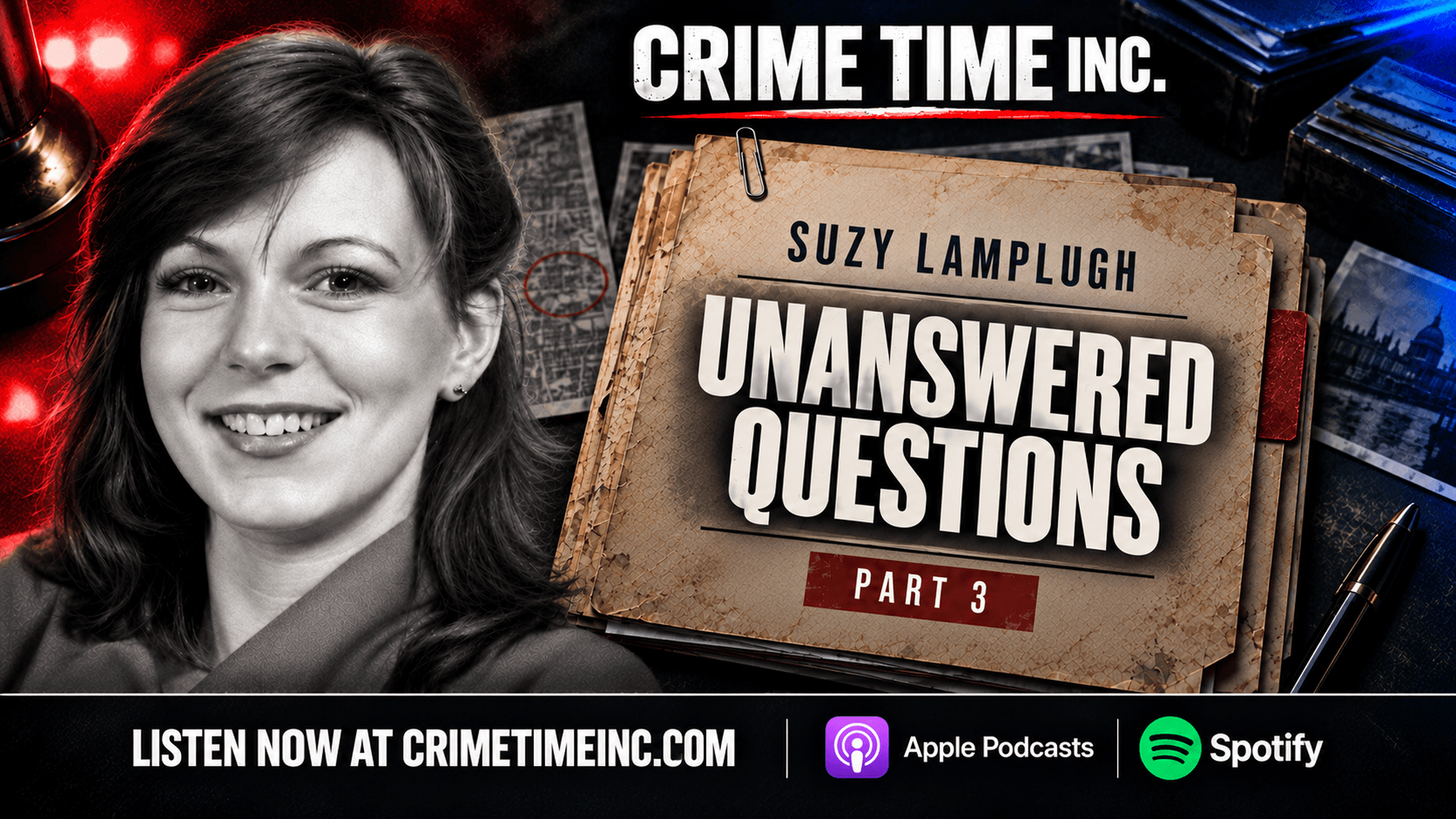
Forty years after Suzy Lamplugh disappeared, the case still carries an extraordinary emotional weight. On 28 July 1986, the 25-year-old estate agent left her Fulham office for an appointment with a client identified only as “Mr Kipper.” She never returned, and Suzy has never been found.
In the final episode of Crime Time Inc’s three-part conversation with former Metropolitan Police detective Mike Barley, the focus shifts from what investigators discovered to the questions that have never gone away.
Mike reflects on the decisions made during the inquiry, the opportunities he wishes had been pursued differently and the personal cost of carrying an unresolved case for decades. Tom Wood and Simon McLean then examine the wider picture—including John Cannan, convicted murderer Steve Wright, and the danger of allowing an attractive theory to become a certainty.
The case that never left Mike Barley
Mike remained connected to the investigation until he left the police in 1999. By then, the case had accompanied him for thirteen years. The worst part, he says, was “living with not knowing” and wondering whether an important detail had been missed.
Every 28 July, Mike stops and remembers Suzy. He also recalls the effect on her parents, Paul and Diana Lamplugh, as detectives repeatedly had to tell them there was no breakthrough.
Mike came to believe that John Cannan was responsible for Suzy’s disappearance. Cannan, who was convicted of murdering Shirley Banks, was never charged with killing Suzy, and Mike is careful to distinguish his personal conclusion from something proved in court.
When Cannan died in prison in November 2024, Mike experienced conflicting emotions. He was relieved that a man he believed remained dangerous would never be released, but saddened that the opportunity to discover what happened to Suzy may have disappeared with him. That moment helped persuade Mike to tell the investigation’s story from the inside.
What would the detectives do differently?
Looking back across four decades is uncomfortable, particularly when today’s investigative tools did not exist in 1986.
There was no modern DNA profiling or searchable national system capable of quickly connecting offences across police areas.
Mike nevertheless identifies decisions he would revisit.
One concerns a witness sighting connected to the man represented in the well-known artist’s impression. Another involves the handling of a crucial interview with John Cannan. A third returns to Norton Barracks, the derelict former military site Mike believed should have been searched much earlier.
By the time later searches took place, the surrounding land had changed dramatically. Parts of the area had been cleared, developed and covered by housing, potentially removing opportunities that had once existed.
Episode 3 allows Mike to explain those regrets in his own words—while also recognising the rank structure, resources and investigative limitations under which detectives were working.
The danger of making the evidence fit the theory
After Mike’s interview concludes, Tom and Simon review all three episodes from the perspective of two former senior detectives.
They are clear that the Metropolitan Police recognised the seriousness of Suzy’s disappearance immediately. Her car was examined promptly, witnesses were pursued and the enormous volume of information generated by the public and media was assessed.
But an unsolved case changes with time. Teams contract, public attention fades and investigators can become so convinced by one suspect or theory that contradictory information receives less attention.
Tom’s rule for reviewing a cold case is simple: accept nothing, believe nothing, check everything. It requires reviewers to separate what the evidence actually shows from what previous investigators—or later commentators—believed happened.
The same discipline must be applied to every name associated with the Suzy Lamplugh case.
Why does Steve Wright enter the Suzy Lamplugh story?
Simon raises one of the other convicted killers whose name has appeared in discussion of the case: Steve Wright, widely known as the Suffolk Strangler.
The possible connection begins with the QE2, where both Wright and Suzy had worked. Wright’s former wife reportedly claimed she had seen them speaking aboard the ship. Questions have also been raised about Wright’s whereabouts when Suzy disappeared and whether the vessel’s crew records provide a conclusive answer.
Tom and Simon do not treat those details as proof. Instead, they test them as experienced investigators would: against the timeline, access controls aboard the ship, the long gap before Wright’s known murders, victim profiles and patterns of approach and body disposal.
The discussion is deliberately cautious. Nothing presented establishes that Steve Wright was involved in Suzy’s disappearance. His inclusion demonstrates how reviewers should examine an alternative suspect without turning a possible connection into an accusation.
The missing piece at the centre of the case
For Tom, patterns of offending and body disposal can reveal a great deal about a serial offender. Familiar locations, routes, methods and victim selection may connect crimes—or show why an apparent connection is weak.
In Suzy’s case, that analysis is severely limited because her body has never been recovered.
There is no confirmed disposal site to compare with other offences and no opportunity for modern forensic science to examine her remains. That brings the conversation back to Norton Barracks and the search Mike wanted to undertake.
Could it have produced something important at the time? What might later development have destroyed or concealed? And was the correct area eventually examined?
Those questions remain unresolved.
Beyond a conviction
Episode 3 also considers what detectives owe victims and their families when a prosecution cannot be delivered.
Paul and Diana Lamplugh responded by creating the Suzy Lamplugh Trust and campaigning for greater awareness of personal safety and the risks faced by lone workers. Mike describes how working practices changed after the case.
Tom makes an important point: police work cannot be measured only by whether someone is convicted. Detectives can also provide families with honesty, respect and support.
Mike was unable to give Suzy’s family the answer they most desperately wanted. But the warmth and respect they continued to show him suggest that his work still mattered.
The disappearance of Suzy Lamplugh remains unsolved. Episode 3 does not pretend otherwise. It offers something rarer: an honest examination of what investigators did well, what they might have done differently and why certainty must never be allowed to outrun the evidence.
Listen to Crime Time Inc: Suzy Lamplugh — Part 3: John Cannan, Steve Wright and the Unanswered Questions at CrimeTimeInc.com, Apple Podcasts, Spotify or wherever you get your podcasts.
Real cases. Real detectives. Real talk.
Mike Barley & Russell Barnes — Suzy Lamplugh: The Inside Story of Britain’s Most Notorious Missing Person Investigation
UK: Amazon UK https://www.amazon.co.uk/dp/B0GX81YK1N
Outside the UK: Search Amazon in your local country for ASIN B0GX81YK1N